Restroom Cleaning Logs That Prove Every Service: From Paper Sheets to Verified Check-Ins

Almost every commercial restroom or washroom has one: a laminated sheet on the back of the door with a grid of times and a column of initials. It is meant to prove the restroom is being looked after. In practice it proves very little - and when a client asks what really happened on Tuesday afternoon, nobody can say for sure.
For facility managers and janitorial contractors, that matters. Restroom quality is the most visible part of a cleaning contract, and the restroom cleaning log is supposed to be the evidence behind it. Here is why paper logs fail, what a trustworthy record needs, and how verified check-ins turn daily work into proof of service.
Why Paper Restroom Cleaning Logs Fail
Paper logs have four structural problems:
- They can be filled in later. Nothing stops a row of initials being added at the end of a shift, or a round being ticked without being done.
- They don't prove presence. A signature shows someone held a pen, not that they were in the restroom at that time.
- They disappear. Sheets get wet, torn, replaced or thrown away, and the history goes with them.
- They never reach anyone. The data stays on the door. Supervisors can't see it in real time, and clients only see it if someone scans a binder.
The result is a record that nobody fully trusts - not the client, not the facility manager, and often not the cleaning team itself, who know their good work isn't being captured either.
What a Trustworthy Cleaning Record Needs
A restroom cleaning log that holds up in a client review or an audit needs five things:
- Location - which restroom, captured automatically, not written by hand
- Time - when the service actually happened, recorded by the system
- Identity - who did it, tied to a personal code rather than a shared login or initials
- Proof of presence - evidence that the check-in happened at the restroom itself
- Context - what was found or fixed, ideally with a photo, and which issue it resolved
If any of these is missing, the log becomes a statement of intent rather than a record of service.
How Verified Check-Ins Work
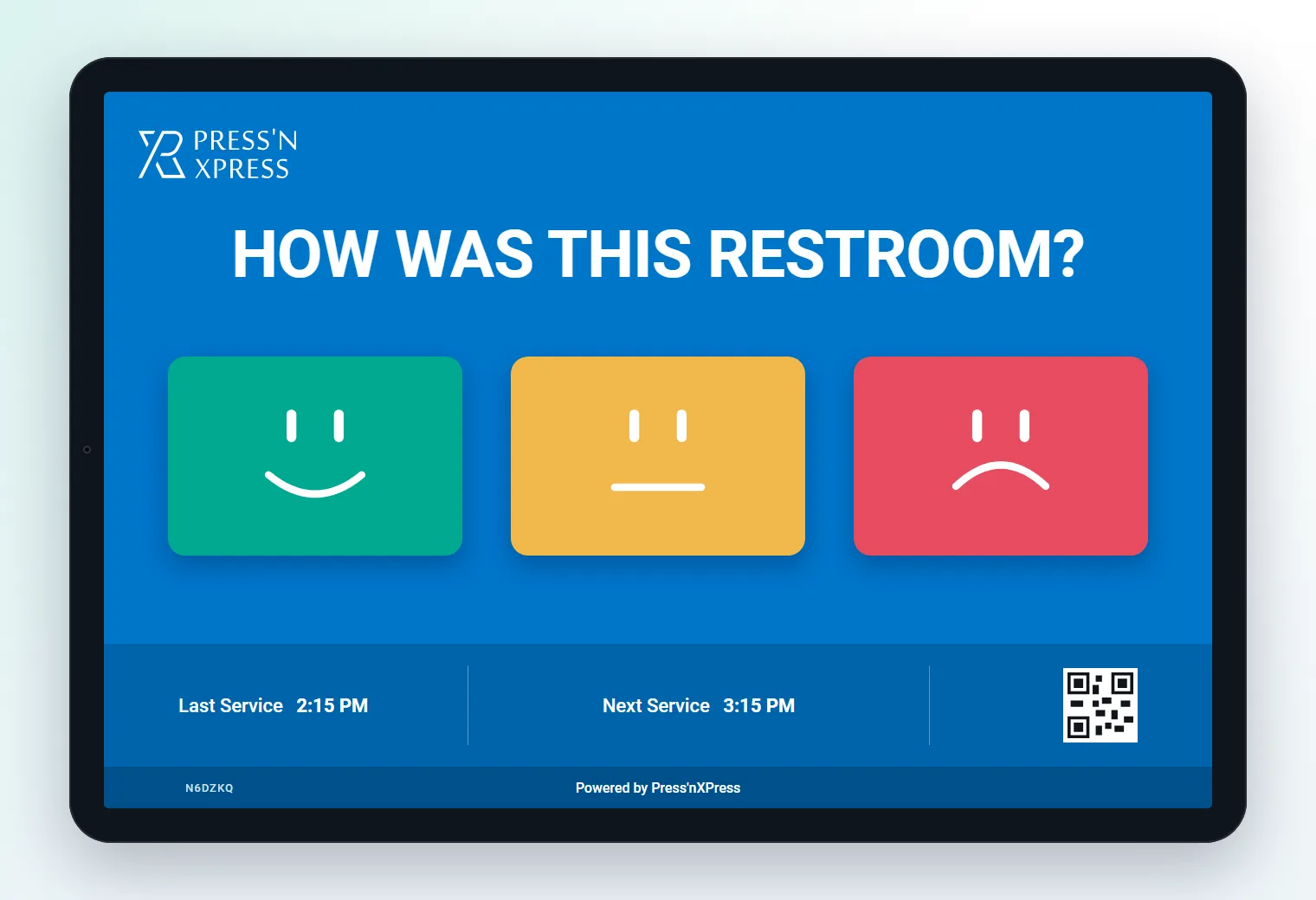
PXP replaces the paper sheet with a check-in that starts at the restroom. The feedback tablet at the door shows a code alongside the restroom's service information. The cleaner scans it with their phone, confirms with their personal code and, if useful, adds a photo of the finished restroom or a maintenance issue.
The service is logged with the restroom, the cleaner and the time. Because the check-in starts from the display on the restroom wall, it can't be completed from the break room or filled in at the end of a shift. And it's quick - a few seconds per service, which matters when a cleaner covers dozens of restrooms a day.
A Service Record Visitors Can See
The same check-in updates the Last Service time shown on the feedback display, next to the Next Service time from the restroom's schedule. Visitors can see at a glance that the restroom is looked after - and because the time only changes when a verified check-in happens, the display keeps the record honest.
Connecting the Log to Work Orders and SLAs
A cleaning log on its own shows routine service. Proof of service becomes much stronger when it's connected to what visitors report and how fast the team responds.
When visitors leave a set number of negative ratings in a row, PXP opens a work order for that restroom and notifies the assigned cleaner by SMS, email or WhatsApp. If it isn't resolved within the SLA, the alert escalates to a supervisor. When the cleaner checks in at the restroom, the work order closes and the resolution time is recorded.
Now every issue has an open time, a resolution time and an owner - the raw material of SLA reporting. Over a month, that adds up to:
- Cleanings completed versus planned, by restroom and shift
- Work orders opened and resolved, and the share resolved within SLA
- Average time to resolve, by restroom, site and team
- Repeat issues per restroom
- Visitor satisfaction trend alongside all of the above
What This Means for Janitorial Contractors
For contractors, the cleaning log is not an internal formality - it is the evidence behind the contract. Clients tend to judge a cleaning partner by the last complaint they heard. Verified, time-stamped service records replace that impression with facts: what was done, when, by whom, and how quickly issues were fixed.
That changes quarterly reviews and renewals. Instead of debating anecdotes, the account team brings a site-by-site record of service and response times. We explore this further in win and keep facility contracts with proof, and for teams that run feedback tablets at their sites, why facility teams are putting the PXP Feedback App on a tablet.
Moving From Paper to Digital
Switching is simpler than most teams expect:
- Start with your most visible restrooms - lobbies, food courts and client-facing areas.
- Install a feedback display at each door and add your cleaners with personal codes.
- Assign each restroom a cleaner and a supervisor, and set its schedule and alert thresholds.
- Run paper and digital side by side for a week so the team gets comfortable, then retire the paper sheet.
- Share the first month's report with supervisors and, for contractors, with the client.
Teams that also count visitors can take the next step and service restrooms by traffic - see usage-based cleaning with people counters.
The Bottom Line
A restroom cleaning log should prove that the restroom was serviced, not just that a box was ticked. Verified on-site check-ins, a visible Last Service time and work orders linked to visitor feedback turn the log into proof of service that clients, auditors and your own team can trust.
It's one part of smart restroom management - and a key step in reducing restroom complaints with data. To see verified check-ins in action, book a demo.
 Press'nXPress Team