Usage-Based Cleaning: How People Counters Let You Clean by Visitor Count, Not the Clock

Walk through almost any building at 12:30 and you will find the same thing: the restroom nearest the food court, lobby or training room is having a very different day from the one on the quiet floor upstairs. Yet in most buildings, both restrooms (or washrooms, depending on where you are) are cleaned on the same timetable.
Fixed cleaning schedules assume every hour, every floor and every day is the same. Visitor counts show that they aren't - and that gap is where most restroom complaints come from. Usage-based cleaning closes it by letting real traffic decide where cleaning time goes.
What Is Usage-Based Cleaning?
Usage-based cleaning (also called demand-based cleaning) schedules service according to how much a space is actually used. Instead of relying only on "every 60 minutes", each restroom also carries a traffic threshold: once a set number of people have used it since its last service, it is flagged for attention.
It does not throw away the schedule. A baseline timetable still guarantees minimum coverage for every restroom. The traffic threshold adds service where and when traffic is higher than planned - and gives you the evidence to reduce rounds where it is consistently lower.
Why Fixed Schedules Fail Busy Restrooms
A fixed schedule is built around an average day. Real buildings have peaks:
- Lunch and breaks in offices and on campuses
- Flight banks in airport concourses
- Shift changes in plants, warehouses and hospitals
- Weekends and events in malls, stadiums and venues
During a peak, a busy restroom might see three or four times its normal traffic between rounds. It fails - odor, mess, empty dispensers - even though the crew did every round on time. Meanwhile a quiet restroom upstairs gets cleaned on schedule whether anyone used it or not. The total cleaning time is fine. It is just in the wrong place.
How People Counters Make It Work
A people counter is an overhead sensor at the restroom entrance that counts people walking in and out. PXP's counter stores anonymous counts only - it counts people, not identities - and reports traffic by hour, day and restroom.
That gives you three things a fixed schedule never had:
- A traffic profile per restroom - which ones carry the load, and when they peak
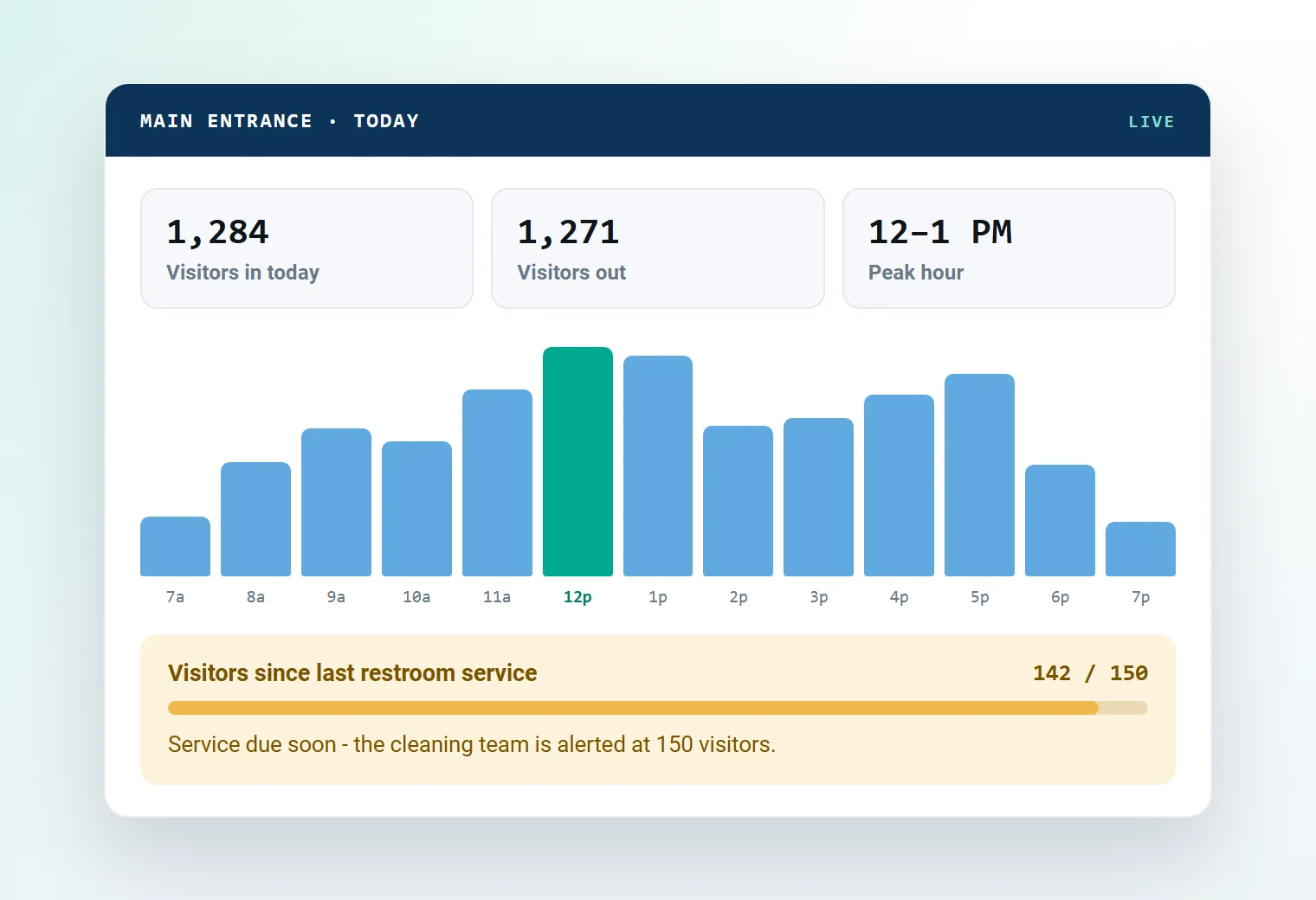
- Visitors since the last service - a live counter that resets when a cleaner checks in
- A fair basis for comparison - complaints per 1,000 visitors instead of raw complaint counts
Setting a Traffic Threshold
The threshold is the number of visitors after which a restroom should be serviced again. There is no universal number - it depends on the size of the restroom, fixture count, the type of building and your standard. The good news is that you don't have to guess:
- Start with the data. Run people counting and feedback side by side for two to four weeks.
- Find the tipping point. Look at how many visitors each restroom typically handles between services while it still rates well, and where ratings start to fall.
- Set the threshold just below it. That way service arrives before the restroom fails, not after.
- Keep the baseline schedule. The threshold adds service; it doesn't remove minimum coverage.
- Review monthly. Occupancy, events and tenant changes shift traffic, so thresholds should move with them.
Combine Traffic With Feedback
Traffic tells you a restroom is busy. It doesn't tell you whether it's failing. That is why usage-based cleaning works best alongside in-the-moment visitor feedback from a tablet, kiosk or QR code at the door.
Together, the two signals separate very different situations:
- High traffic, good ratings - the schedule is coping; leave it
- High traffic, falling ratings - add service at peak, or lower the threshold
- Low traffic, poor ratings - a quality or maintenance problem, not a capacity one
- Low traffic, good ratings - a candidate for fewer rounds
When negative ratings cross a restroom's alert threshold, a work order opens and the assigned cleaner is notified by SMS, email or WhatsApp, with escalation to a supervisor if the SLA is missed. Our restroom feedback system use case shows how teams set this up.
Complaints per 1,000 Visitors: The Fair KPI
Raw complaint counts punish your busiest restrooms. Ten complaints from a food-court restroom that saw 6,000 visitors is a better result than four complaints from an office restroom that saw 800. Once you count visitors, you can normalize:
- Complaints (or negative ratings) per 1,000 visitors - comparable across every restroom and site
- Visitors per service - how much traffic each cleaning round actually covers
- Feedback participation rate - responses as a share of visitors, a check that your feedback point is visible and working
These numbers also change the conversation with clients and leadership: from "we had complaints" to "complaints per visit fell after we moved two rounds to the lunch peak."
Rolling Out Usage-Based Cleaning
A practical rollout looks like this:
- Pick your busiest three to five restrooms - usually near entrances, food areas or waiting rooms.
- Install people counters and feedback displays, and turn on verified cleaning check-ins so the "visitors since last service" counter resets reliably.
- Collect two to four weeks of baseline data without changing the schedule.
- Set thresholds and reassign rounds from quiet restrooms to busy ones.
- Measure complaints per 1,000 visitors and SLA results before and after.
Verified check-ins matter here: the counter can only reset when a cleaning is genuinely confirmed at the restroom. See restroom cleaning logs that prove every service for how that works.
The Bottom Line
Usage-based cleaning doesn't ask crews to work harder. It asks the plan to follow the people. With anonymous visitor counts, a traffic threshold per restroom and live feedback alongside it, cleaning time moves to where it's needed - and complaints fall without adding hours.
It is one of the four loops in smart restroom management, alongside listening to visitors, automating work orders and verifying every service. For the full plan, read how to reduce restroom complaints with data - or book a demo to see usage-based cleaning on your own restrooms.
 Press'nXPress Team