Win and Keep Facility Contracts With Proof: Real-Time Feedback as SLA Evidence

Every facility services account manager has lived this moment. The quarterly business review is going well — staffing is stable, costs are on budget — and then the client says: "We've had a lot of complaints about the restrooms on level four." Nobody in the room has data to confirm or deny it. The conversation shifts from performance to perception, and perception is shaped by whatever the client heard most recently.
That's the core problem with how many cleaning and facility contracts are managed. Performance is real, but evidence is thin. Periodic audits capture a moment. Complaint logs capture the worst moments. Neither tells the full story of how a building is actually being looked after, day in and day out.
Real-time feedback, linked to work orders and cleaning records, changes that. It gives facility services companies a continuous, objective record of service quality — the kind of evidence that holds up in a client review and wins renewals.
Why Contracts Are Won and Lost on Perception
Facility services is a high-stakes, low-visibility business. When it's done well, nobody notices — the restrooms are clean, the lobby is tidy, the supplies are stocked. When something slips, everyone notices, and one bad washroom can define a client's view of an entire contract.
Without data, a few problems compound:
Recency bias. The client remembers the complaint from last Tuesday, not the eleven weeks of good service before it.
No baseline. A complaint log can't show that a restroom is rated well 95% of the time.
No attribution. It's hard to show whether an issue was a cleaning failure, a supply problem, or a maintenance defect that belongs to someone else.
No speed record. Even when an issue was fixed in ten minutes, there's no proof unless someone wrote it down.
Contracts get re-tendered on this basis all the time — not because service was poor, but because the incumbent couldn't prove it was good.
The Three Layers of SLA Evidence
Real SLA evidence comes from three connected data sources, all captured continuously.
1. Occupant feedback by zone and restroom. Visitors and tenants rate restrooms, washrooms, lobbies, and break rooms through QR codes, tablets running the PXP Feedback App, or Smiley Feedback Terminals. Every response is tied to a precise location, giving each zone and each restroom a score over time — good days included.
2. Work orders and resolution times. When feedback crosses a threshold, Action Hub workflows raise an alert and create a work order, assigned to the right associate. PXP records time to acknowledge and time to resolve for every one. (We walk through this in From Feedback to Work Order in Minutes.)
3. Cleaning and attendance records. Where associates log rounds or check-ins on site tablets, you have a record of scheduled cleaning actually completed — by associate, location, and facility.
Individually, each layer is useful. Together, they tell a complete story: what occupants experienced, what the team did about it, how fast, and whether routine work was delivered as contracted.
Mapping Feedback to Your Contract Thresholds
Evidence only matters if it speaks the language of the contract. During onboarding, PXP maps zones and service lines to the thresholds in each client agreement — for example, "restroom satisfaction at or above 85%" or "supply issues resolved within 30 minutes."
From then on, scores and work order times are tracked against those thresholds automatically. Account managers can see at a glance which zones are on track, which are approaching a boundary, and which have breached. And because alerts fire before a breach, the team can intervene while there's still time — rather than discovering a problem at the client review.
For a deeper look at how this works at the site level, see our facility services use case.
The SLA Scorecard to Bring to Every Client Review
Here's the scorecard structure we recommend facility services teams bring to every quarterly business review:
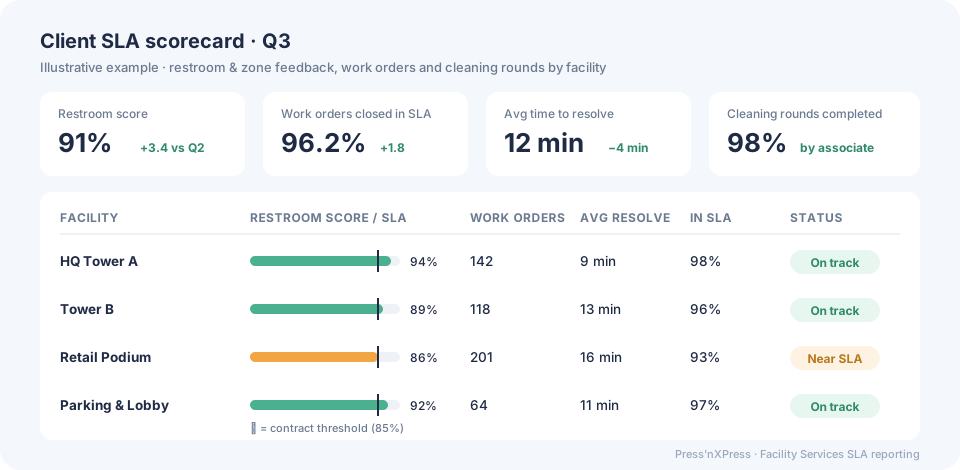
Feedback score by facility, zone, and restroom. Against the contracted threshold, with the quarter-over-quarter trend. Highlight the restrooms and washrooms that improved most.
Work orders by facility and restroom. Volume, issue mix (supplies, cleaning, maintenance), and repeat work orders. Repeats point to root causes worth discussing — a broken fixture, an undersized supply cabinet, a traffic pattern that's changed.
SLA compliance by work order. The percentage of work orders resolved within the agreed time, by facility. This is often the single most persuasive number in the room.
Average time to acknowledge and resolve. By site and by issue type, so the client sees how fast the team actually responds.
Cleaning and attendance by associate, location, and facility. Round completion against schedule, and where gaps line up with dips in restroom scores.
What we changed. Two or three concrete actions taken based on the data — a round moved to after lunch peak, a dispenser upgraded, a supply par level raised — and the effect on scores.
That last section turns the review from a report into a partnership. You're not just showing numbers; you're showing that you use them to improve the client's building.
Turning Positive Feedback Into Crew Recognition
SLA evidence isn't only for clients. The same data shows which associates and shifts consistently keep their restrooms and areas rated highly. Routing positive feedback back to the crew members responsible — and recognizing them at the shift level — is one of the most reliable ways to reduce turnover in a deskless workforce.
Lower turnover means more consistent service, which means better scores, which means stronger evidence at the next review. It's a loop worth investing in.
Using Evidence to Win New Business
The same data that protects renewals also wins new contracts. When a bid team can show a prospective client real restroom scores, resolution times, and SLA compliance from comparable sites, the proposal stops being a list of promises and starts being a track record.
Some facility services companies go further and offer real-time feedback and work order reporting as part of the contract itself — a transparent, client-facing dashboard that differentiates them from competitors still relying on monthly audits.
Getting Started
- Pick one strategic client — ideally one with a renewal in the next six to twelve months.
- Map their contract thresholds to zones and restrooms in PXP.
- Deploy collectors at the restrooms, washrooms, and common areas that matter most to them.
- Set work order rules aligned to the SLA response times.
- Bring the first scorecard to the next client review, even after just six to eight weeks.
For background on restroom feedback itself, see Your Restrooms Are Talking, and for the device most facility teams use on site, see Why Facility Teams Are Putting the PXP Feedback App on a Tablet.
The Bottom Line
Facility services contracts shouldn't be decided by the last complaint a client heard. Real-time restroom and washroom feedback, linked to work orders and cleaning records, gives you continuous, objective proof of the service you deliver — proof that protects renewals, strengthens client relationships, and wins new business.
Ready to turn your service quality into SLA evidence? Book a demo and we'll build a sample scorecard for one of your client sites.
 Press'nXPress Team