How to Reduce Restroom Complaints: A Data-Driven Cleaning Plan

In any busy building, restrooms - or washrooms, as they're called across Canada - work like a public scorecard. People judge them in seconds, and that judgment follows them through the rest of the visit. A single complaint about odor, a mess or an empty soap dispenser usually points to something bigger than one bad moment - it means the cleaning plan and the way the building is actually used have drifted apart.
The good news is that the fix rarely means hiring more staff. It means putting cleaning time where it is needed, catching problems before visitors do, and proving that the work was done. The classic advice - audit your traffic, restock early, track complaints, train for quality - is sound. The difference in 2026 is that each of those steps can now run on live data instead of clipboards and guesswork.
Here is a seven-step plan to reduce restroom complaints, and the data that makes each step work.
Why Restroom Complaints Keep Coming Back
Most restroom problems start with timing. A restroom next to a lobby, food court, clinic waiting room or training room might need several touch-ups between formal cleanings. If the crew follows a fixed route, that restroom fails during the busiest hour of the day - even though every round was completed on time.
Reactive work adds to it. By the time someone calls the help desk, the visitor has already formed an opinion of the building. Supplies are the most preventable problem of all - empty soap, towels and tissue - yet they remain among the most common complaints. And high-touch surfaces such as faucet handles, flush valves, stall locks and door pulls show grime long before the rest of the room looks dirty.
Underneath all of these is a data gap. Cleaners, supervisors and facility managers rarely share the same view of how busy each restroom is, what visitors are saying, and when it was actually last serviced. That is why the same restrooms keep generating the same complaints.
Step 1: Measure Real Traffic, Not Assumed Traffic
Every good restroom cleaning plan starts with foot traffic. The traditional approach is a one-off audit: someone counts visitors for a few days and the schedule is adjusted. The problem is that traffic changes with seasons, events, occupancy and tenant moves, so the audit is out of date within weeks.
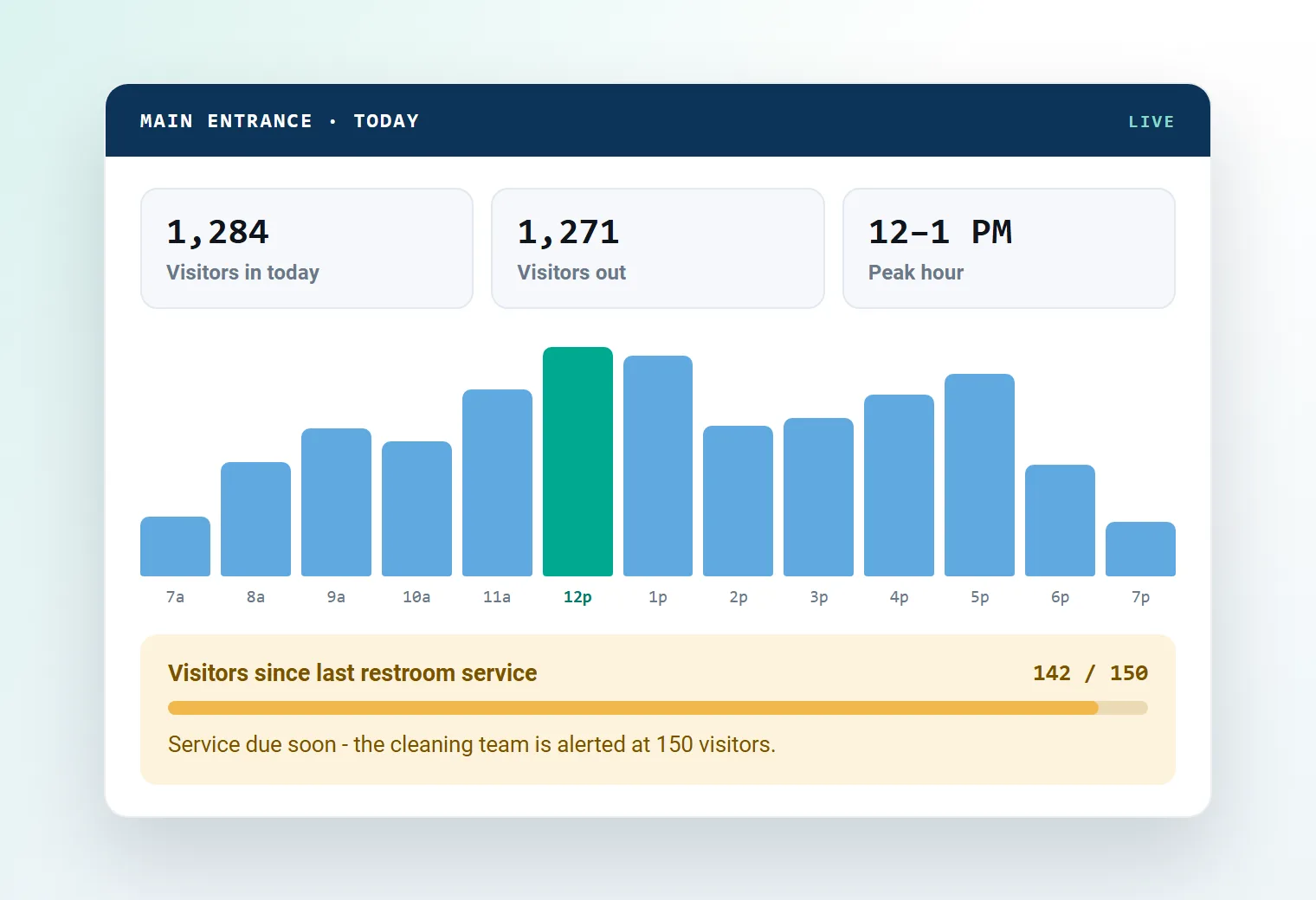
A people counter at the restroom entrance solves this permanently. It counts visitors in and out - anonymously, with no images or personal data - and shows traffic by hour, day and restroom. Within a week you can see which restrooms carry the load, when they peak, and which ones are being cleaned far more often than their traffic justifies.
Step 2: Ask Visitors in the Moment
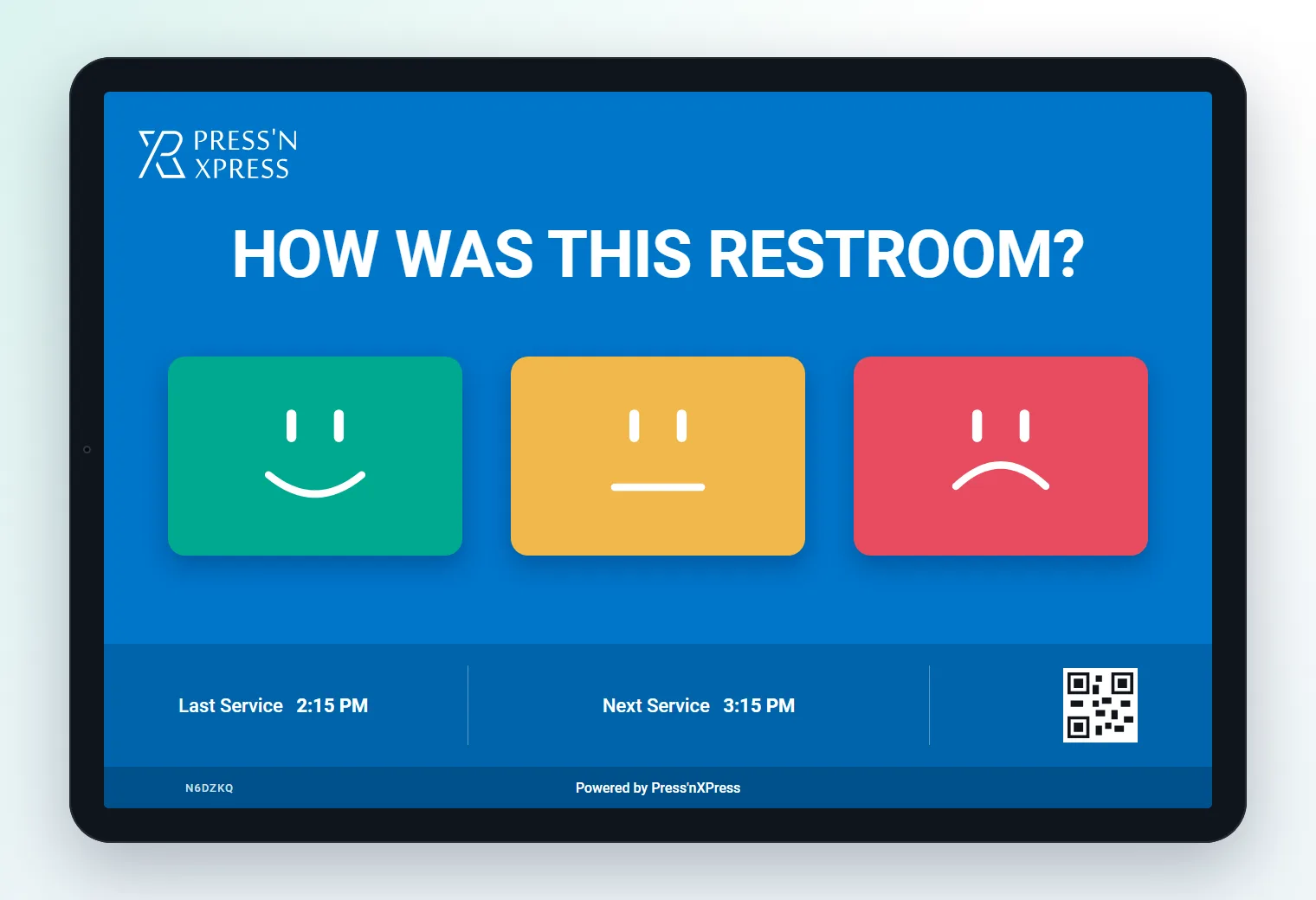
Traffic tells you how busy a restroom is. Feedback tells you how it is performing. The most useful restroom feedback is captured at the door, in the moment, with no app or login: a one-tap rating, followed by a reason such as cleanliness, supplies, odor or maintenance.
A wall-mounted feedback tablet, touch-free kiosk or QR code ties every response to a specific restroom and time. Unlike a complaint line, it also captures the positive ratings, so you get a baseline to measure against instead of a log of failures. Our restroom feedback system use case covers how teams place and configure these collectors.
Step 3: Turn Negative Feedback Into Work Orders Automatically
A complaint form only reduces complaints if someone acts on it quickly. The weak point of most QR-code forms is that submissions land in an inbox that gets reviewed weekly.
Instead, set an alert threshold for each restroom - for example, a number of negative ratings in a row. When the threshold is reached, a work order opens automatically for that restroom with the reason attached, and the cleaner assigned to it is notified by SMS, email or WhatsApp. If the work order is still open when the SLA passes, the alert escalates to a supervisor. Every step is time-stamped, so you can see exactly how long each issue took to resolve.
This is the core of PXP Action Hub: thresholds, work orders, notifications and escalation, running on their own.
Step 4: Restock Before Dispensers Run Out
Empty dispensers are the easiest complaint to prevent. The traditional fix is to restock at set times - mid-morning and mid-afternoon - and use visual indicators so staff can check levels quickly. That works, but fixed restock times have the same weakness as fixed cleaning rounds: they ignore traffic.
Two data points make restocking proactive. First, the "supplies" reason in visitor feedback shows which restrooms run out, and when. Second, the number of visitors since the last service is a reliable early warning: a restroom that has had three times its usual traffic since its last check is likely to be running low, whatever the clock says.
Step 5: Verify Every Service on Site
Paper cleaning logs on the back of the door are the weakest link in most restroom programs. Initials can be added at the end of a shift, rounds can be ticked without being done, and nobody can prove what happened when a client asks.
Verified check-ins replace them. The cleaner confirms each service at the restroom itself - scanning the code on the restroom's feedback display and confirming with a personal code, with an optional photo - and the service is logged with the restroom, the cleaner and the time. The same check-in updates the Last Service time visitors see on the display, which also tells them the restroom is looked after. We cover this in depth in restroom cleaning logs that prove every service.
Step 6: Clean by Usage, Not Just the Clock
Once you are counting visitors, you can go one step further: service restrooms by usage. Alongside the regular schedule, each restroom gets a traffic threshold - service after a set number of visitors since its last check-in. Busy restrooms get attention at the moment they need it, and quiet ones stop absorbing rounds they don't need.
This is how teams reduce complaints without adding hours: the same cleaning time, moved to where the traffic is. Our guide to usage-based cleaning with people counters explains how to set thresholds and roll it out.
Step 7: Review Weekly With the Right KPIs
Data only changes outcomes if someone looks at it. A short weekly review with supervisors and frontline staff keeps small problems from becoming patterns. Focus on a handful of restroom KPIs:
- Complaints per 1,000 visitors - the fair way to compare a busy restroom with a quiet one
- Work orders resolved within SLA - and the average time to resolve
- Cleanings completed vs. planned - by restroom and by shift
- Repeat issues per restroom - the same reason coming back means a root cause, not bad luck
- Visitor satisfaction trend - by restroom, floor and site
Share the results with the team, and recognize the cleaners whose restrooms consistently score well. Positive feedback routed back to the people who earned it is one of the cheapest ways to keep quality high.
Where to Start
You don't need to transform every restroom at once. Most teams start with the three to five restrooms that generate the most complaints:
- Put a feedback display at each door and turn on verified check-ins.
- Set alert thresholds and assign a cleaner and supervisor to each restroom.
- Add people counting to the busiest restrooms.
- Review the KPIs above every week for a month, then adjust schedules and thresholds.
For janitorial contractors, the same data becomes contract evidence - see how real-time feedback becomes SLA evidence at client reviews.
The Bottom Line
Reducing restroom complaints doesn't require constant over-cleaning. It requires better timing, early warnings, fast response and proof that the work was done. Traffic data, in-the-moment feedback, automatic work orders and verified check-ins turn each of those from good intentions into a system that runs every day.
That system is what we call smart restroom management. If you'd like to see it on your own restrooms, book a demo and we'll help you plan a pilot.
 Press'nXPress Team