Toilet Feedback System: How Washroom Feedback Works in Busy Facilities

A washroom is the one part of a building almost every visitor uses and almost nobody comments on - until it goes wrong. Then the comment usually lands in a public review rather than with the person who could have fixed it. A toilet feedback system closes that gap: it gives every visitor a one-second way to rate the washroom on the way out, and it gives the cleaning team a live signal about which toilets need attention now.
This guide explains how a toilet feedback system works, which collectors suit which washrooms, how alerts reach the right cleaner without flooding their phone, and what to check before you choose one.
What a Toilet Feedback System Does
At its simplest, a toilet feedback system asks one question at the washroom - "How clean is this washroom?" - and records the answer with the exact location and time. The useful systems go three steps further:
- They ask why. After a low score, the visitor picks the issue: no toilet paper, empty soap, bad smell, wet floor, bin full, faulty flush.
- They alert the right person. When a washroom crosses its alert rule, a work order opens for that washroom and the assigned cleaner is notified by SMS, email or WhatsApp.
- They prove the fix. The cleaner checks in at the washroom, the work order closes with its resolution time, and the record is there for supervisors, clients and auditors.
Without the last two steps, washroom feedback is just a satisfaction score. With them, it becomes a way of running the cleaning operation. That is the difference between a counter on the wall and a restroom feedback system that actually changes how often visitors find an empty dispenser.
The Collectors: Terminal, Tablet, QR Code and SMS
Most facilities end up using more than one collector, because a motorway service area, an office floor and a hospital ward have very different washrooms.

Smiley terminals are the classic toilet feedback machine: three faces by the exit, answered in a second. They win at the busiest washrooms - airports, rail stations, shopping centres and malls, stadiums - where you want a rating from as many people as possible. The PXP TouchFree model is answered by holding a hand over a face, so nobody touches a shared surface in a washroom. It runs on a battery that lasts over a year and connects through a built-in SIM card, so there is no cabling and no corporate Wi-Fi involved. Terminal sites regularly see response rates of 30% or more.
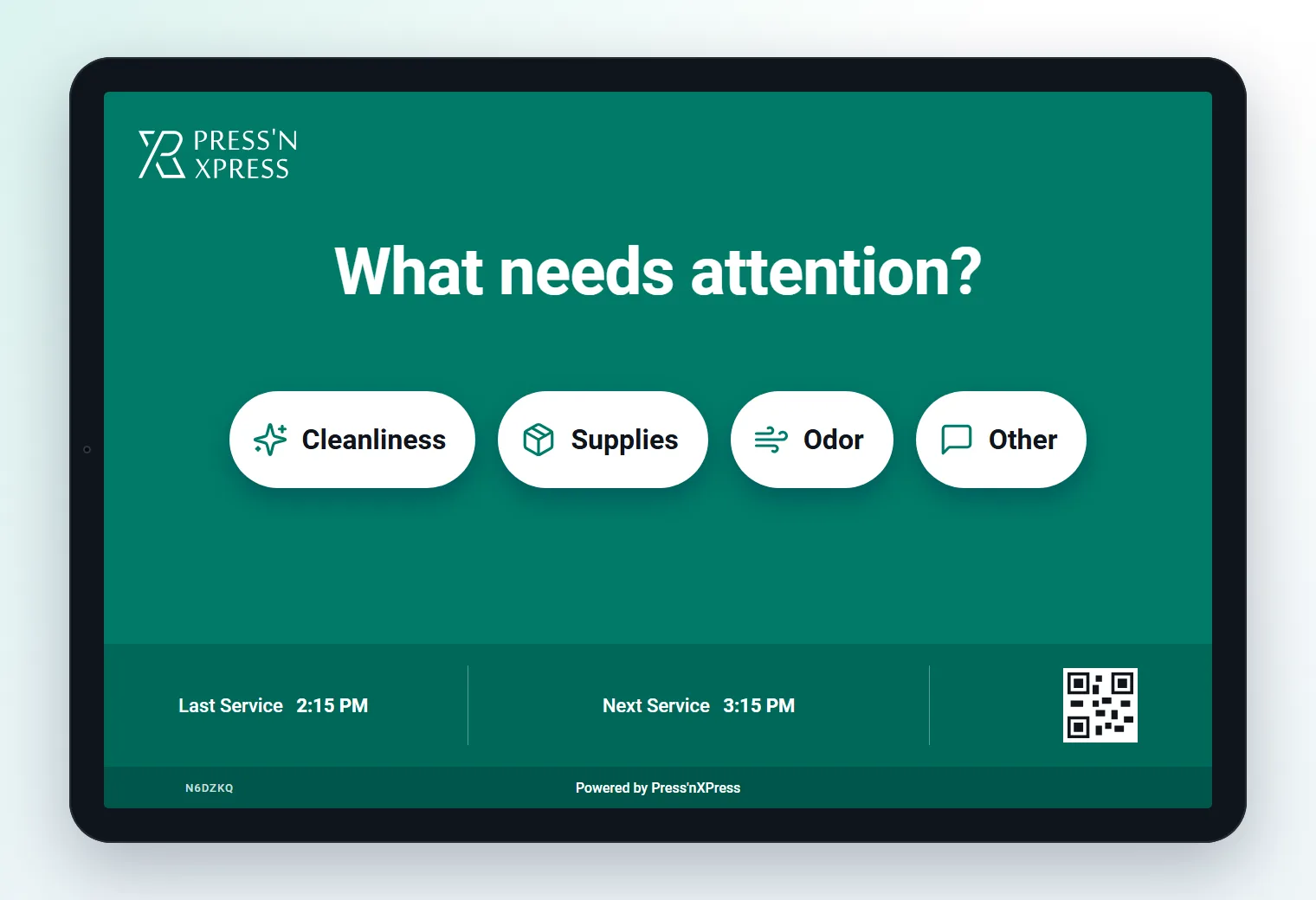
Tablets suit washrooms where a richer answer is worth one more tap - offices, hotels, hospitals and premium venues. A wall-mounted tablet running the PXP Feedback App can ask more than one question, show your branding, display when the washroom was last cleaned and next due, and let cleaners log a verified check-in on the same screen.
QR codes cost almost nothing and work anywhere: on the inside of the washroom door, on the back of each stall door, or on a mirror sticker. Visitors answer on their own phone, with no app and no account. They are ideal for smaller washrooms, for every stall in a large block, and as a second option next to a terminal.
SMS is the fallback for low-connectivity areas and for visitors who prefer to text. In PXP it feeds the same pipeline as the other collectors rather than a separate inbox.
Issue Tags: The Detail That Makes Feedback Useful
A low rating tells you a washroom has a problem. An issue tag tells you which problem - and that decides who should go. A short list works best:
- No toilet paper or out of paper towels - a restock for the cleaner on that floor
- Empty soap - a restock with the dispenser location
- Bad smell - a cleaning priority, flagged if it keeps coming back
- Wet floor or needs cleaning - an immediate clean, with the slip risk visible to supervisors
- Bin full - added to the next round or sent now
- Faulty flush, tap, lock or hand dryer - a work order for maintenance, not cleaning
Routing by issue is what stops a cleaner walking to a washroom with a mop when the real problem is a broken tap.
Alerts That Don't Exhaust the Cleaning Team
The fastest way to kill a washroom feedback program is to send a cleaner a message every time anyone taps an unhappy face. Good alert rules are about patterns, not single taps:
- Per-washroom thresholds, such as three negative ratings in a row, open a work order only when there is a real problem.
- The issue tag decides the recipient, so maintenance problems don't land on the cleaning team.
- SLA timers escalate only what stays open. If a work order is still unresolved when its target passes, the supervisor is alerted - not before.
- Traffic can trigger cleaning too. Add a people counter at the entrance and busy washrooms can be serviced after a set number of visitors, not only by the clock.
Delivery status matters as much as the alert itself. When every SMS, email or WhatsApp notification is tracked, a supervisor can see whether the cleaner received it, not just whether it was sent.
One System, Many Languages and Sites
Washrooms in airports, stations and malls serve visitors from everywhere. PXP surveys can run in any language, so each site can ask in the languages its visitors actually speak - English, French, Arabic, German or others - while every response rolls up into one dashboard. For groups that run washrooms across many buildings or countries, that single view is what makes comparison fair: complaints per 1,000 visitors, resolution time by site, and which washrooms consistently need extra rounds.
What to Ask Before You Choose a Toilet Feedback System
Most washroom feedback products look similar on the wall. The differences show up behind it:
- Does a low score open a work order, or just send an email?
- Can cleaners prove the fix with an on-site check-in and a timestamp?
- Is there a touchless option, and does it need our Wi-Fi or a power socket?
- Can visitors pick the issue, and does the issue decide who is alerted?
- Can surveys run in every language our visitors speak?
- Can we compare washrooms fairly by traffic, not only by raw complaint counts?
If a system answers yes to all six, it will change how your washrooms are run, not just how they are measured. For a deeper look at the operational side - usage-based cleaning, verified check-ins and SLA reporting - see smart restroom management, and for why rated feedback beats a text-in line, read restroom and washroom feedback vs the complaint hotline.
The Bottom Line
A toilet feedback system is not about collecting more scores. It is about getting the right cleaner to the right washroom before the next visitor walks in - and being able to prove it happened. Start with the five busiest washrooms, mix a terminal or tablet at the exits with QR codes in the stalls, set sensible alert rules, and review resolution times every week.
Want to see how it would work in your washrooms? Book a demo and we'll help you plan a pilot.
Frequently Asked Questions
What is a toilet feedback system?
A toilet feedback system lets visitors rate a toilet or washroom in seconds - on a smiley terminal, a tablet, a QR code or by SMS - and pick the reason when something is wrong, such as no toilet paper or a bad smell. Low ratings alert the cleaner responsible for that washroom straight away, and every rating, work order and cleaning visit is recorded for reporting.
How does a toilet feedback machine work?
A toilet feedback machine is a small wall-mounted terminal with three smiley faces. Visitors press or, on a touchless model, hover a hand over a face as they leave. After a low score it can ask what needs attention. The response is sent to a dashboard over its own connection, and a run of low ratings triggers an alert to the cleaning team.
Does a washroom feedback terminal need Wi-Fi or a power socket?
Not with PXP. The smiley terminal runs on a battery that lasts over a year and connects through a built-in SIM card, so it can be mounted outside a washroom without cabling, a nearby socket or access to your corporate Wi-Fi.
Is a tablet or a terminal better for washroom feedback?
Use a terminal where speed matters most - busy washroom exits in airports, stations and shopping centres - because one hover or press is all it takes. Use a tablet where a richer answer is worth one more tap, such as office, hotel or hospital washrooms, because it supports multi-question surveys, issue tags, your branding and a last-cleaned display. Many sites mix both, with QR codes in smaller washrooms.
Can washroom feedback surveys run in more than one language?
Yes. Questions can be set up in any language, so a site can ask visitors in the languages they actually speak - for example English, French, Arabic or German - while all responses roll up into one dashboard.
 Press'nXPress Team