One visit crosses many environments
Parking, reception, waiting, diagnostics, consultation, wards, washrooms, pharmacy and discharge are often run by different teams on different systems.
Use Cases / Healthcare
Patient & Facility Experience
Capture patient and visitor feedback at every touchpoint of the hospital journey - from registration to the washroom to discharge - and route each issue to the team that can resolve it before it becomes a complaint.
Start with one clinic, ward or washroom block.
Overview
A real-time patient feedback system collects ratings from patients and visitors at the moment of care - by clinic, ward, washroom and shift - and routes each problem to the team that owns it, so it can be fixed during the visit instead of discovered weeks later in a survey.
Patients do not experience registration, clinical care, environmental services, pharmacy, facilities and discharge as separate departments. They experience one visit. A hospital, though, is run by many teams, each with its own systems and its own view of quality. Real-time patient feedback gives all of those teams the same live picture of how the visit is going, touchpoint by touchpoint.
Parking, reception, waiting, diagnostics, consultation, wards, washrooms, pharmacy and discharge are often run by different teams on different systems.
A dirty washroom, an unexplained delay or a missed explanation loses its recovery value the moment the patient leaves the building.
Wait time, communication, responsiveness, cleanliness, comfort, wayfinding and supplies all shape the same experience in the patient's mind.
It does not replace HCAHPS or other post-discharge patient experience surveys - those remain the standardized benchmark. It fills the gap between survey waves with daily, location-level signals, and it is strongest exactly where surveys are weakest: the facility side of the experience. Washroom cleanliness, supplies, noise at night, wayfinding and waiting-room comfort can usually be fixed in minutes or hours, if the right team hears about them in time.
The Problem
Traditional patient surveys are good at benchmarking. They rarely tell operations where an issue is happening right now, who owns it, or what question to ask next.
Most patients never file a complaint. They just score you lower later.
Every unreported issue is a recovery you never got the chance to make.
“Our survey told us cleanliness scores fell last quarter. It couldn't tell us it was the second-floor visitor washrooms, on weekends, when supply runs slipped.”
The result is a familiar loop: a quarterly report shows a drop, a committee debates the cause, and an improvement plan targets the whole hospital. Meanwhile the real issue - one clinic's registration desk at 9 a.m., or one washroom block on a weekend - keeps happening to new patients every day. Real-time feedback breaks that loop by tying every signal to a place, a time and an owner.
How It Works
Every zone feeds the same experience layer - physical collectors, digital channels, AI theme analysis and Action Hub workflows - and every alert goes to the team that owns that part of the visit.
First impressions, accessibility, wayfinding and check-in - where a confusing entrance or long registration line sets the tone for the whole visit.
Alerts go to Front desk & patient access
Measure the wait, then find out where the delay actually happens - registration, the provider, or diagnostics.
Alerts go to Clinic operations
Find friction in handoffs, explanations, service speed and medication pickup between departments.
Alerts go to Diagnostics & pharmacy leads
Capture responsiveness and care-environment signals during the stay - while there is still time to act on them.
Alerts go to Nursing unit leadership
Spot cleanliness, supply, odor, maintenance and accessibility issues in the moment, by floor and by washroom.
Alerts go to Environmental services & facilities
Measure clarity and confidence at the end of the visit, then follow up by SMS or email once the patient is home.
Alerts go to Patient relations
Collection is self-serve, so none of this adds a step for nurses or clinicians. How point-of-care feedback avoids staff burden
Where Feedback Is Captured
Every collector is tied to a specific location, so a rating from the second-floor washroom never gets mixed up with one from the outpatient waiting room.
A one-gesture rating with no screen to touch - a natural fit for infection-conscious waiting areas, clinic exits and cafeterias.
Touch-free feedback kioskA code on the bedside table, ward door or washroom opens a short survey on the patient's or visitor's own phone - no app, no login.
QR code & tap feedbackThe PXP Feedback App on a wall-mounted tablet, with reason buttons configured per location and optional cleaning-round check-ins.
Feedback App for tabletsA short follow-up once the patient is home - discharge clarity, medication confidence and anything they didn't say on site.
SMS feedbackMost hospitals combine channels. Touchless kiosks capture volume at waiting-room exits and cafeterias, where people pass by in large numbers. QR codes reach patients at the bedside, where they have time to say more. Wall-mounted tablets suit wards and washroom doors, where reason buttons can be tailored to the space. SMS and email follow up after discharge, when patients can reflect on the whole visit.
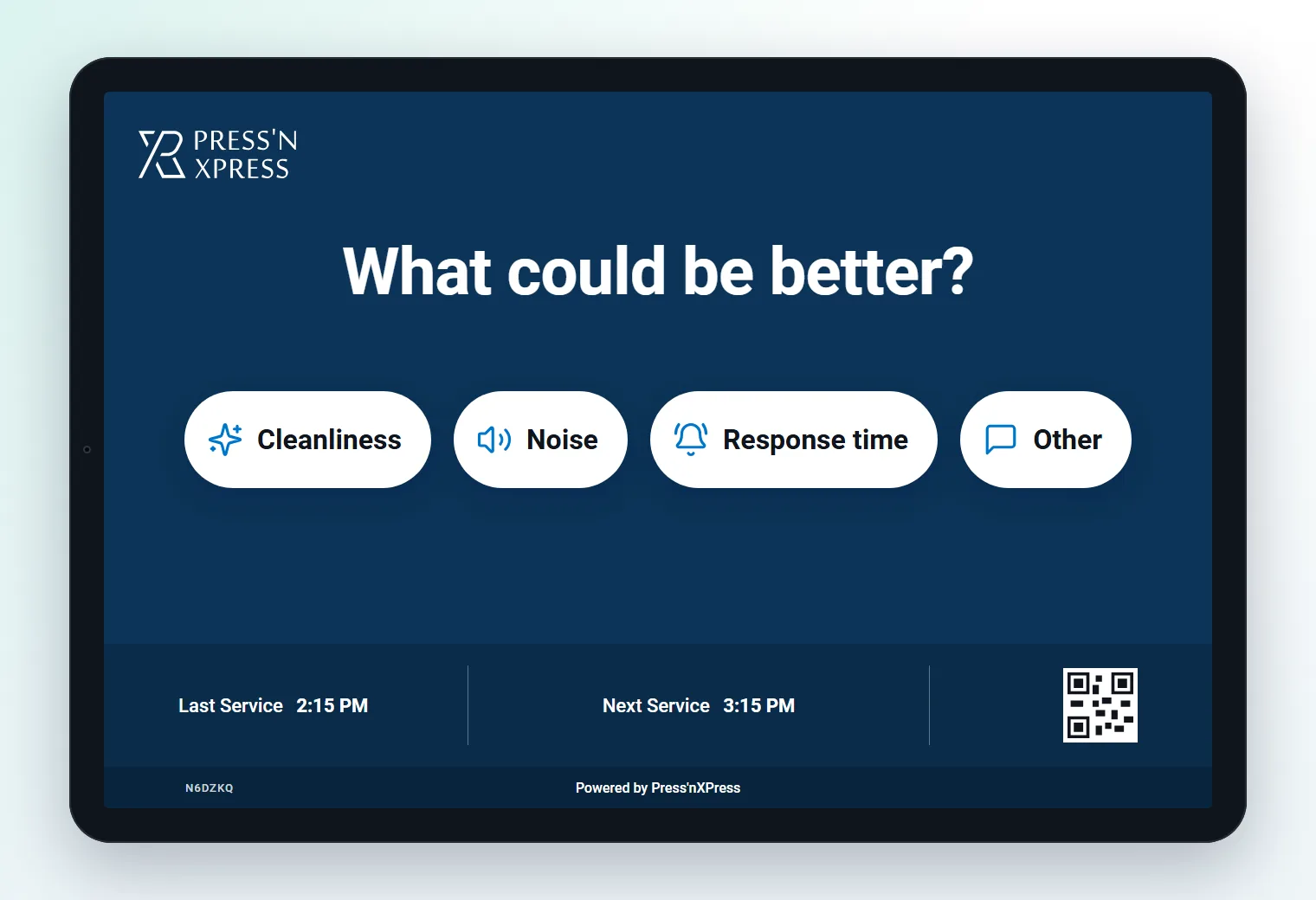
On wards, a tablet asks patients and visitors what could be better - cleanliness, noise, response time - and routes each answer to the right team. The service bar along the bottom can show when the area was last cleaned and when the next round is due, and environmental services staff can log their check-in on the same device.
The PXP Feedback Ladder
A touchpoint that keeps asking the same satisfaction question learns nothing new once a problem is clear. PXP lets teams configure a ladder of follow-up questions for each location - and can move down it automatically, then return to baseline after the fix.
Measure the baseline. Stable locations stay in monitoring mode.
Identify the driver: wait time · communication · cleanliness · nursing.
Locate the problem: registration · provider · diagnostics · pharmacy.
Set the standard - patients define the expectation instead of management guessing it.
Prioritize the fix: better information · more capacity · a better waiting environment.
Re-measure after the intervention to prove whether it actually changed the experience.
Each rung narrows the problem. The baseline question shows that something changed, the next shows which driver changed, and the one after that shows where in the process it happens. Once the evidence is clear, the ladder can ask patients what would help most - so the improvement budget goes to the fix patients actually value. After the change, the terminals return to the original question and the score shows whether it worked.
The Outcome
Leadership sees where attention should go first. Each department and facility team sees the locations it owns.
| # | Touchpoint | Experience | Trend | Status |
|---|---|---|---|---|
| 01 | Ward 5 — Nursing | 91% | ↑ 6 | Strong |
| 02 | Main Reception | 86% | ↑ 2 | On track |
| 03 | Discharge | 81% | – 0 | Stable |
| 04 | Diagnostic Imaging | 75% | ↓ 3 | Watch |
| 05 | Visitor Washrooms | 64% | ↓ 7 | Act |
| 06 | Outpatient Waiting | 48% | ↓ 11 | Priority |
Location-level views put every response on the map - by building, floor, ward and washroom - so a falling score points to a specific place, not a hospital-wide average. Comparisons by weekday, hour and shift separate a one-off from a pattern, and the same views roll up across every hospital and clinic in a health system. Touchpoint names and figures here are illustrative.
Comparing many hospitals or clinics? See what a multi-site feedback platform needs to do. Multi-location feedback buyer's guide
Example
A queue problem is detected, diagnosed, routed and re-measured while the morning clinic is still running.
A cluster of negative ratings appears at the outpatient clinic during the morning peak.
The score is well below the normal pattern for the same touchpoint at the same weekday and hour - not just a bad few minutes.
The outpatient kiosks and tablets move from the satisfaction question to “Where did you wait longest?” - Registration · Provider · Pharmacy/Lab.
Registration becomes the dominant answer. The issue is now a specific bottleneck, not a generic “wait time” complaint.
Action Hub sends the issue to the clinic operations lead with the response volume, touchpoint and comments attached. A second registration desk opens.
The terminals return to the baseline question, and PXP measures whether the change actually improved the patient experience.
Every alert is tracked from the moment it fires to the moment it is closed, with an owner and a deadline. Inside the closed loop with Action Hub
Why PXP
Formal surveys set strategy and benchmarks. Real-time feedback runs the day-to-day operation between survey waves.
| Dimension | Post-discharge survey | Complaints & comment cards | PXP real-time feedback |
|---|---|---|---|
| Timing | Days to weeks after the visit | Only when someone is upset enough | During the visit, every day |
| Granularity | Hospital or service line | One story, no pattern | Per clinic, ward, washroom, shift and hour |
| Coverage | Sampled patients | The loudest few | Patients and visitors at every touchpoint |
| Action | Next improvement cycle | Manual follow-up | Routed to the owning team, tracked to close |
| Proof | Next survey wave | None | Re-measured at the same touchpoint |
The two work best together. Many of the themes behind HCAHPS - staff responsiveness, communication, quiet at night, and the cleanliness of rooms and bathrooms - are things a hospital can see and fix during the stay if it hears about them in time. Real-time feedback gives units that early warning, while the formal survey keeps measuring the overall result.
How the two programs fit together, theme by theme: Beyond HCAHPS: real-time patient feedback
Privacy & Staff
Feedback should make the care team's day easier, not add another task - and it should never put patient data at risk.
Collection is entirely self-serve. Patients and visitors rate on a kiosk, tablet or their own phone; nobody has to hand out a survey or chase a response. Alerts go directly to environmental services, facilities, food services or clinic operations, so nurses are not the routing layer for problems they don't own. Positive feedback flows back to the teams it is about, which matters for recognition and retention in demanding roles.
Kiosk, tablet and QR feedback is anonymous by default and asks for no personal information. A patient who wants a follow-up can choose to leave contact details. PXP is designed with privacy-by-default principles: PII collection is minimized, access is role-based, and enterprise deployments support encryption, audit logging and retention controls.
Built for Every Care Setting
The same feedback loop, configured for the way each care setting runs.
Inpatient and emergency environments with many teams behind one patient experience.
High-volume visits where the wait is the experience.
Short, anxious visits with several handoffs.
Residents, families and visitors over months, not hours.
One view across every site - and evidence for the teams that run environmental services and facilities.
Healthcare EVS and facility management contractors use the same evidence to win and keep contracts. Real-time feedback as SLA evidence
Running cleaning and maintenance across several buildings? See how site-level feedback works for FM teams. Facility services use case
FAQ
What patient experience, operations and facilities teams ask before deploying PXP.
Yes. Each clinic, ward, waiting area and washroom is set up as its own touchpoint, with its own questions and alert routing, while still rolling up into a hospital, region or health-system view.
Yes. Questions are managed centrally and change remotely - no reprinting and no site visit. Teams can configure a ladder of follow-up questions for each touchpoint, and PXP can move a location from its baseline question to a diagnostic one automatically when its score drops, then return to baseline to check whether the fix worked.
Yes. Every response is time-stamped and tied to its touchpoint, so scores can be compared by weekday, hour, shift and period. That separates a local problem, such as a night-shift ward or a Monday-morning clinic, from a hospital-wide average.
No. HCAHPS and other post-discharge surveys remain the standardized benchmark for patient experience. Real-time feedback complements them by capturing signals during the visit, so teams can fix issues before discharge and before they show up in survey results.
It shouldn't. Collection is self-serve through kiosks, QR codes and tablets, and alerts route straight to the department that owns the issue - environmental services, facilities, food services or clinic operations - rather than adding a step to clinical workflows.
Kiosk, tablet and QR feedback is anonymous by default and does not ask for personal information. Patients can choose to leave contact details if they want a follow-up. PXP is designed with privacy-by-default principles - PII collection is minimized, access is role-based, and enterprise deployments support encryption, audit logging and retention controls.
A tablet, kiosk or QR code at public washrooms lets patients and visitors rate cleanliness and pick a reason such as supplies, odor or maintenance. Negative responses route to environmental services as an alert or work order, so the washroom is fixed while people are still in the building.
Yes. Beyond one-tap ratings, PXP supports multiple-choice reasons, open comments, voice notes, conditional question flows, and email or SMS surveys after discharge when a deeper conversation is needed.
Business Impact & ROI
The return comes from fixing the right thing, in the right place, while it still matters to the patient.
Resolve issues while the patient is still in the facility, before they become complaints or low survey scores.
Move beyond “wait time” and isolate the actual bottleneck - registration, provider, diagnostics or pharmacy.
Use live experience signals to prioritize cleaning, restocking and maintenance where they matter most.
Learn which intervention patients value most before committing budget to it.
Connect every issue to the team, location and workflow that owns it.
Re-measure the original baseline and show whether the fix actually worked.
See It Live
Bring one hospital, clinic or patient journey to a 30-minute demo. We'll map your touchpoints, questions, teams and feedback ladder - then start with a pilot on one unit.
Further Reading
Guides on running real-time feedback in hospitals and clinics.
Related PXP Pages
The products and use cases behind patient and facility feedback.