Closed-Loop Feedback: How to Recover a Service Failure Before the Customer Walks Away

Closed-Loop Feedback: How to Recover a Service Failure Before the Customer Walks Away
Most unhappy customers never tell you they are unhappy. They simply stop coming back. By one widely cited estimate, only about 1 in 26 dissatisfied customers actually complains - the other 25 vote with their feet. That single statistic is the whole case for closed-loop feedback: the goal is not to collect more opinions, it is to catch a service failure while the customer is still standing in front of you and there is still time to make it right.
A traditional survey, sent days after the visit, arrives long after that window has closed. Closed-loop feedback flips the model. You capture how someone feels in the moment, route the problem to the person who can fix it, and follow up before a quiet disappointment hardens into a lost customer and a one-star review. This post breaks down what closed-loop feedback actually is, why the timing matters so much, and how to build a service-recovery loop that runs every day without adding work for your frontline team.
What "Closing the Loop" Really Means
Closing the loop is the difference between hearing feedback and acting on it. An open loop ends when the data lands in a dashboard: a score dips, a comment gets logged, and nobody does anything specific about that one customer. A closed loop ends when the individual who had the bad experience has been heard, helped, and - ideally - won back.
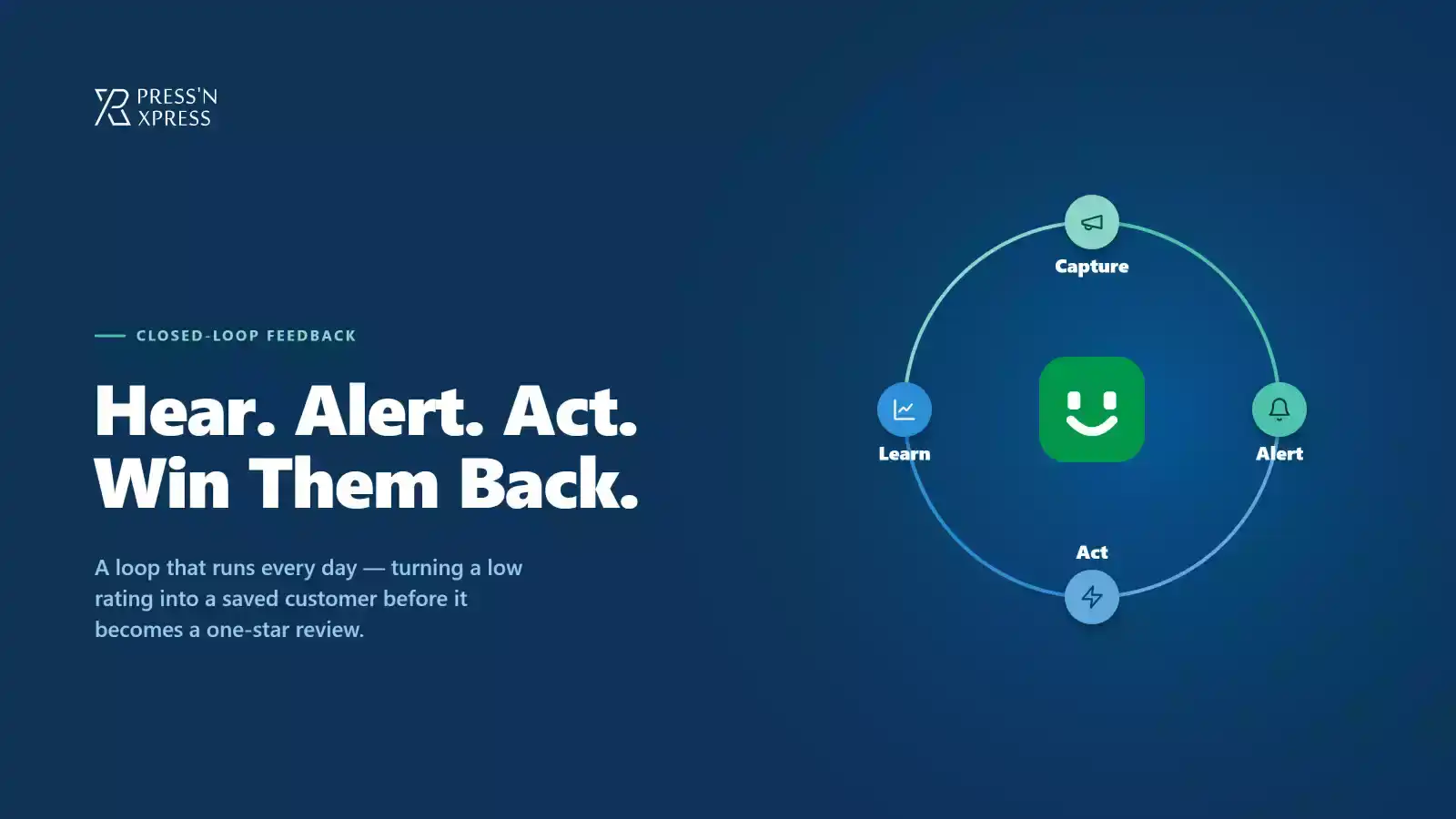
A genuine closed-loop process has four moving parts. First, capture the feedback at the point of experience, not weeks later. Second, alert the right person the moment something goes wrong, so a low rating becomes a task rather than a statistic. Third, act - reach out, apologize, fix the underlying issue, and recover the relationship. Fourth, learn by feeding recurring problems back into operations so the same failure does not keep happening across locations.
There are really two loops working together. The inner loop is individual service recovery: one upset customer, one fast response. The outer loop is systemic improvement: spotting that the same complaint shows up every Friday night at the same branch and changing how you staff it. Strong programs run both at once.
Why Speed Is the Whole Game
Service recovery has a short shelf life. The emotional intensity of a bad experience fades fast, and so does your opportunity to influence it. Reach a frustrated customer within minutes or hours and a sincere fix can turn the moment around - this is the well-documented "service recovery paradox," where a problem resolved well can leave customers more loyal than if nothing had gone wrong at all. Reach them a week later and the apology reads as a formality.
Speed is also what protects your public reputation. A customer whose complaint is handled privately and quickly rarely feels the need to broadcast it. The same customer, ignored, often turns to Google or social media - where the audience is no longer one person but every future prospect researching your business. Closing the loop fast is, in practice, review-damage prevention.
And there is an operational payoff. The faster feedback reaches a location manager, the cheaper the fix. A spill flagged in real time is a five-minute cleanup; the same spill surfaced in next month's report is a month of degraded experiences you can no longer recover.
Why Traditional Surveys Leave the Loop Open
Periodic email and phone surveys were never built for recovery. They struggle on three fronts at once.
The timing is wrong. Feedback collected days after the fact cannot drive same-day action, because the moment - and often the customer - is already gone.
The response rates are low and skewed. When only a small, self-selected slice replies, the quiet majority who simply left unhappy stay invisible, and you optimize around a sample that does not represent your customers.
And the data is hard to act on. A spreadsheet of scores tells you that satisfaction dipped, not who to call or what to do this afternoon. Without routing and ownership, even good data dies in a dashboard.
Closed-loop feedback is designed to fix exactly these gaps: capture in the moment, alert automatically, and hand a specific person a specific action.
Building a Service-Recovery Loop That Actually Runs
A closed loop only works if it survives a busy Saturday. A few principles keep it durable.
Meet customers where the experience happens. Capture feedback at the point of service through whatever fits the moment - a feedback kiosk or smiley terminal at the exit, a QR code on the receipt, an SMS or email after a digital interaction. Omnichannel collection means you hear from far more people than any single survey would reach, and a one-tap rating earns dramatically higher response rates than a ten-question form.
Make a bad score trigger an action, not a log entry. The instant a rating falls below your threshold or a comment signals a problem, the right manager should get an alert with the context they need. This is the hinge of the entire loop: feedback has to become a task with an owner and a clock on it.
Give the frontline a simple way to respond. Recovery should not require a committee. The person closest to the customer needs a clear path to reach out, resolve, and mark the issue closed - so nothing slips through and you can see how quickly loops are actually being closed.
Turn comments into signal. At volume, no one can read every response. AI-assisted sentiment analysis sorts the urgent from the routine and surfaces the themes worth fixing systemically, so your team spends its time acting rather than triaging.
Watch the patterns, not just the incidents. Individual recoveries win back individual customers. The recurring complaints are where you fix the process - the staffing gap, the confusing signage, the slow checkout - so the same failure stops generating new unhappy customers next week.
From Feedback to Loyalty
Done well, closing the loop changes what feedback is for. It stops being a backward-looking report card and becomes a live early-warning system - one that lets you intercept a service failure while you can still do something about it. Customers notice when a business listens and responds quickly; that responsiveness is often what turns a near-miss into renewed trust. The mechanics are not complicated: capture in the moment, alert the right person, act fast, and learn from the patterns. The hard part is committing to run that loop every day - which is exactly where a real-time feedback platform earns its keep.
Want to see what closing the loop looks like in your locations? Talk to the Press'nXPress team and we'll walk you through it.
 Press'nXPress Team